
Class 6 English Grammar Worksheet on Order of Adjectives

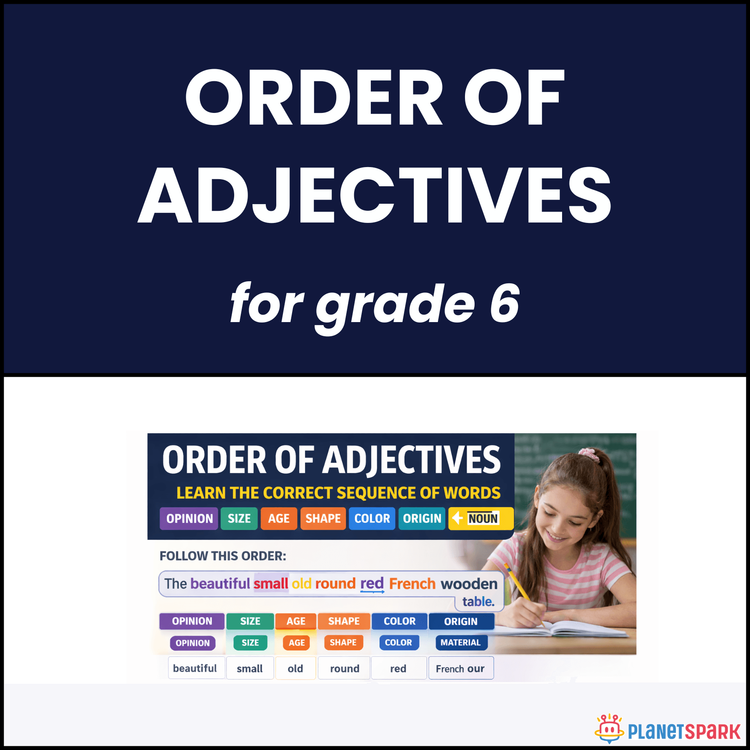
Class 6 English Grammar Worksheet on Order of Adjectives
Order Matters: Mastering Adjective Sequences for Class 6
This Grade 6 worksheet focuses on the precise rules of the "Order of Adjectives" and the identification of Adjective Phrases. Students will learn the standard sequence (Opinion, Size, Age, Shape, Colour, Origin, Material, Purpose) to ensure their descriptions sound natural and fluent. Through a variety of tasks—including underlining phrases, choosing correct sequences, and narrative completion—learners move from simple descriptions to sophisticated, accurate writing.
Book a free trial!
Why Order of Adjectives Matters in Grammar?
Using multiple descriptors correctly is vital for clear communication. For Grade 6 learners, this topic is important because:
1. It prevents awkward phrasing (e.g., "a wooden small box") and ensures academic accuracy.
2. Adjective phrases add depth and detail, allowing students to specify exactly which noun they are discussing.
3. It builds a foundation for creative writing and descriptive essays.
4. Mastery of these rules helps students sound more like native speakers in both speech and writing.
Book a free trial!
What’s Inside This Worksheet?
This worksheet includes five grammar-rich activities to build descriptive fluency:
🧠 Exercise 1 – Underline and Circle
Students identify the adjective phrase (a group of words acting as an adjective) and circle the specific noun it describes. Example: "The girl (noun) with the long braided hair (phrase)."
✏️ Exercise 2 – Multiple Choice Questions
Learners select the grammatically correct sentence from three options, reinforcing the standard adjective hierarchy.
📋 Exercise 3 – Sentence Rewriting
Students apply grammar rules to fix jumbled or incorrectly ordered adjectives. Example: "a red big ball" becomes "a big red ball."
📝 Exercise 4 – Fill in the Blanks (The Mysterious Attic)
A storytelling task where students must arrange three bracketed adjectives in the correct order to reveal hidden treasures in an attic.
✍️ Exercise 5 – Paragraph Writing
A creative task where students write an original paragraph about the "ENVIRONMENT" using correct adjective sequences.
Book a free trial!
✅ Answer Key (For Parents & Educators)
Exercise 1 – Underline Phrase (Circle Noun)
1. girl (with the long braided hair) 6. cake (from the new Italian bakery)
2. house (on the corner of the street) 7. cave (filled with sparkling crystals)
3. man (of great wisdom) 8. dress (of shimmering silk)
4. students (from the local school) 9. bridge (over the deep blue river)
5. dog (with the bright red collar) 10. chair (made of dark oak wood)
Exercise 2 – Choose Correct Order
1. a small wooden box 6. a tiny blue pen
2. a big red ball 7. a round glass table
3. a beautiful silk dress 8. a pretty pink scarf
4. a tall old building 9. a long narrow road
5. a large new car 10. a small brown dog
Exercise 3 – Rewritten Sentences
1. a small wooden box 6. a tiny blue pen
2. a big red ball 7. a pretty pink scarf
3. a beautiful silk dress 8. a long narrow road
4. a tall old building 9. a round glass table
5. a large new car 10. a small brown dog
Exercise 4 – Fill in the Blanks
1. heavy old wooden 5. beautiful antique French
2. shiny small gold 6. tiny silver metal
3. brown rectangular leather 7. lovely red silk
4. oversized blue woollen 8. interesting stone Egyptian
Exercise 5 – Paragraph Writing
Answers may vary.
sample answer : The environment around us includes many beautiful natural elements that need care. In the park, I saw tall green trees, colorful small flowers, and a clear blue sky above. A cool gentle breeze made the place feel fresh and calm. We must protect these precious natural resources from harmful human activities. By making small daily changes, we can help keep our environment clean, safe, and healthy.
Transform your child’s writing from basic to brilliant with PlanetSpark’s expert-led English Communication classes.
🔖Book a free trial!
Frequently Asked Questions
Adjectives follow a fixed order like size, color, shape, and purpose.
Because multiple adjectives can be arranged incorrectly without knowing rules.
Through repeated practice using common adjective sequence patterns.