
Class 6 Worksheet on Reciprocal Pronouns

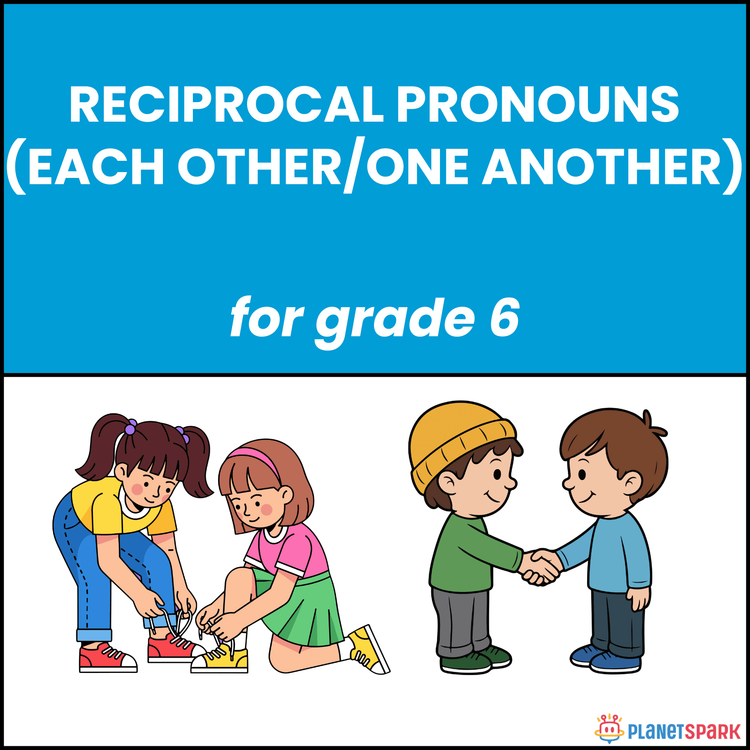
Class 6 Worksheet on Reciprocal Pronouns
Together in Grammar: Mastering Reciprocal Pronouns (Each Other / One Another) for Grade 6
This Grade 6 worksheet helps students master reciprocal pronouns — "each other" and "one another" — which show mutual actions or feelings between two or more people. Through multiple-choice questions, fill-in-the-blanks, matching exercises, underlining tasks, and paragraph writing, learners understand when to use "each other" (typically for two people) and "one another" (typically for three or more), while avoiding common confusions with reflexive pronouns like "themselves."
Why Reciprocal Pronouns Matter in Grammar?
Reciprocal pronouns express shared or mutual actions, which are common in everyday communication. For Grade 6 learners, this topic is important because:
1. "Each other" is typically used when two people are involved in a mutual action.
2. "One another" is typically used when three or more people are involved.
3. These pronouns replace longer phrases like "helped him and he helped her" with simple, elegant grammar.
4. They help students write and speak more naturally about teamwork, relationships, and group activities.
What’s Inside This Worksheet?
This worksheet includes five engaging activities that build fluency with reciprocal pronouns:
🧠 Exercise 1 – Multiple Choice Questions
Students read 10 sentences and choose the correct reciprocal pronoun ("each other" or "one another") or identify incorrect options like "themselves."
✏️ Exercise 2 – Fill in the Blanks
Students complete 10 sentences by filling in the correct reciprocal pronoun ("each other" or "one another") based on context and number of people involved.
🔗 Exercise 3 – Match the Following (True or False)
Students read 10 statements about reciprocal pronoun rules (e.g., "Each other is used when talking about two people") and mark them as true or false.
📝 Exercise 4 – Underline the Reciprocal Pronoun
Students read 10 sentences and underline the reciprocal pronoun ("each other" or "one another") in each sentence.
📖 Exercise 5 – Paragraph Writing (Circle the Reciprocal Pronouns)
Students read a paragraph about students working on a science project and circle all reciprocal pronouns to show mutual actions or feelings.
Help your child express teamwork and mutual actions with confidence using the correct reciprocal pronouns.
🔹 Answer Key
Exercise 1 – Multiple Choice Questions
1. b) They helped each other
2. a) each other
3. a) each other
4. a) each other
5. b) each other
6. a) one another
7. b) each other
8. a) each other
9. a) one another
10. b) each other
Exercise 2 – Fill in the Blanks
1. each other
2. each other
3. one another
4. one another
5. each other
6. each other
7. one another
8. each other
9. one another
10. one another
Exercise 3 – True or False
1. True
2. False
3. True
4. True
5. False
6. False
7. True
8. False
9. False
10. False
Exercise 4 – Underline the Reciprocal Pronoun
1. each other
2. each other (Note: "The teacher and the students" — more than two, but "each other" is acceptable in modern usage)
3. one another
4. each other
5. one another
6. each other
7. one another
8. each other
9. each other
10. one another
Exercise 5 – Circle the Reciprocal Pronouns (from paragraph)
The students in the class worked hard together on their science project. They helped [each other] gather materials, sharing ideas and resources. Whenever one of them was stuck, the others would offer suggestions, encouraging [one another]. During their group discussions, they listened to [each other's] opinions and made sure everyone's voice was heard. After a long week of collaboration, they finally completed their project. They celebrated their success together, congratulating [each other] for the teamwork that led to their achievement. Even after the project was done, they promised to continue supporting [one another] in future projects. They knew they could always rely on [each other], whether it was for school or just to hang out after class.
Frequently Asked Questions
Reciprocal pronouns like "each other" and "one another" show mutual action or relationship between two or more people or things.
They often confuse them with reflexive pronouns or fail to use them in the correct context.
Practice exercises guide students to identify and use reciprocal pronouns correctly in context.