
Class KG English Worksheet on Lowercase Letter Tracing

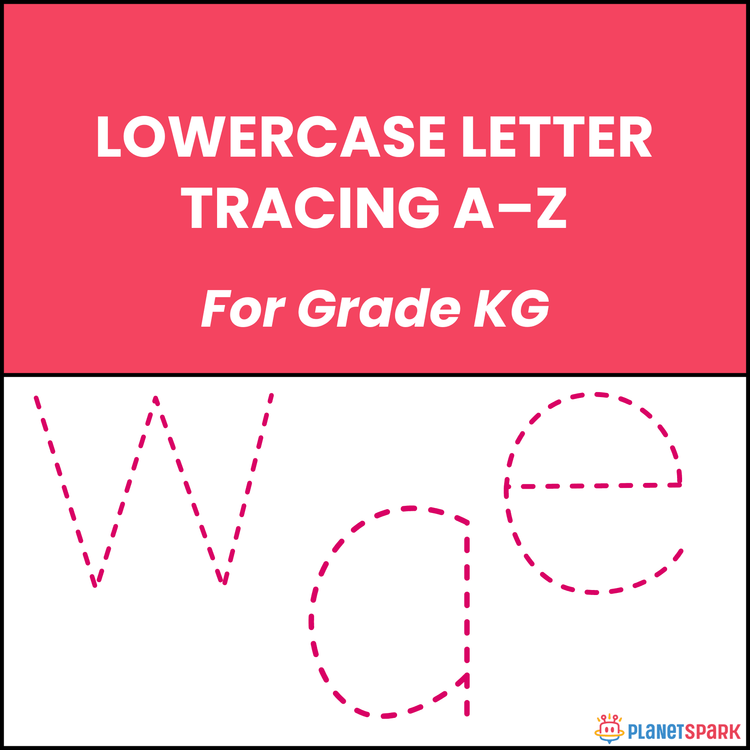
Class KG English Worksheet on Lowercase Letter Tracing
Small Letters, Big Confidence: Lowercase Letter Tracing a–z for KG
This Kindergarten worksheet on Lowercase Letter Tracing a–z helps young learners practise correct small letter formation through guided, step-by-step tracing activities. Designed especially for KG students, this worksheet builds strong foundational writing skills by focusing on letter shapes, stroke direction, and repetition.
Through grouped tracing practice (a–f, g–l, m–r, s–z, and stroke-by-stroke formation), children strengthen fine motor control, hand-eye coordination, and alphabet recognition. Repeated tracing patterns help build muscle memory, ensuring smoother and more confident writing.
Why Lowercase Letter Tracing Matters in Early Learning?
Practising small letters helps children:
1. Develop correct letter formation and stroke sequence.
2. Improve pencil grip and writing control.
3. Strengthen recognition of commonly used letters in reading.
4. Prepare for writing simple words and sentences independently.
What’s Inside This Worksheet?
🧠 Exercise 1 – Trace Small Letters (a–f)
Children carefully trace lowercase letters a, b, c, d, e, and f using dotted guides.
✏️ Exercise 2 – Trace Small Letters (g–l)
Students practise letters g, h, i, j, k, and l, focusing on tail letters and straight strokes.
📋 Exercise 3 – Trace Small Letters (m–r)
Children trace m, n, o, p, q, and r, practising curved and loop strokes.
🔤 Exercise 4 – Trace Small Letters (s–z)
Students trace s, t, u, v, w,x, y and z carefully, improving curve and slant control.
🔘 Exercise 5 – Step-by-Step Stroke Tracing
Children trace lowercase letters A–R in paired uppercase-lowercase format (Aa, Bb, Cc, etc.) by following numbered stroke directions.
ANSWER KEY (For Parents & Educators)
Exercise 1 – Letters Traced
a b c d e f
Exercise 2 – Letters Traced
g h i j k l
Exercise 3 – Letters Traced
m n o p q r
Exercise 4 – Letters Traced
s t u v w x y z
Exercise 5 – Letters Traced Step-by-Step
Aa Bb Cc
Dd Ee Ff
Gg Hh Ii
Jj Kk Ll
Mm Nn Oo
Pp Qq Rr
(Tracing neatness and accuracy may vary depending on the child’s fine motor development stage.)
Help your child build smooth, confident handwriting with structured lowercase tracing practice designed especially for Kindergarten learners.
🔖Book a free trial!
Frequently Asked Questions
Lowercase letters are used more often in reading and writing.
It helps children learn correct letter shapes and spacing.
Some letters look similar, so tracing builds clarity.